RAG Evaluation: Chunks, Embeddings and Top-k
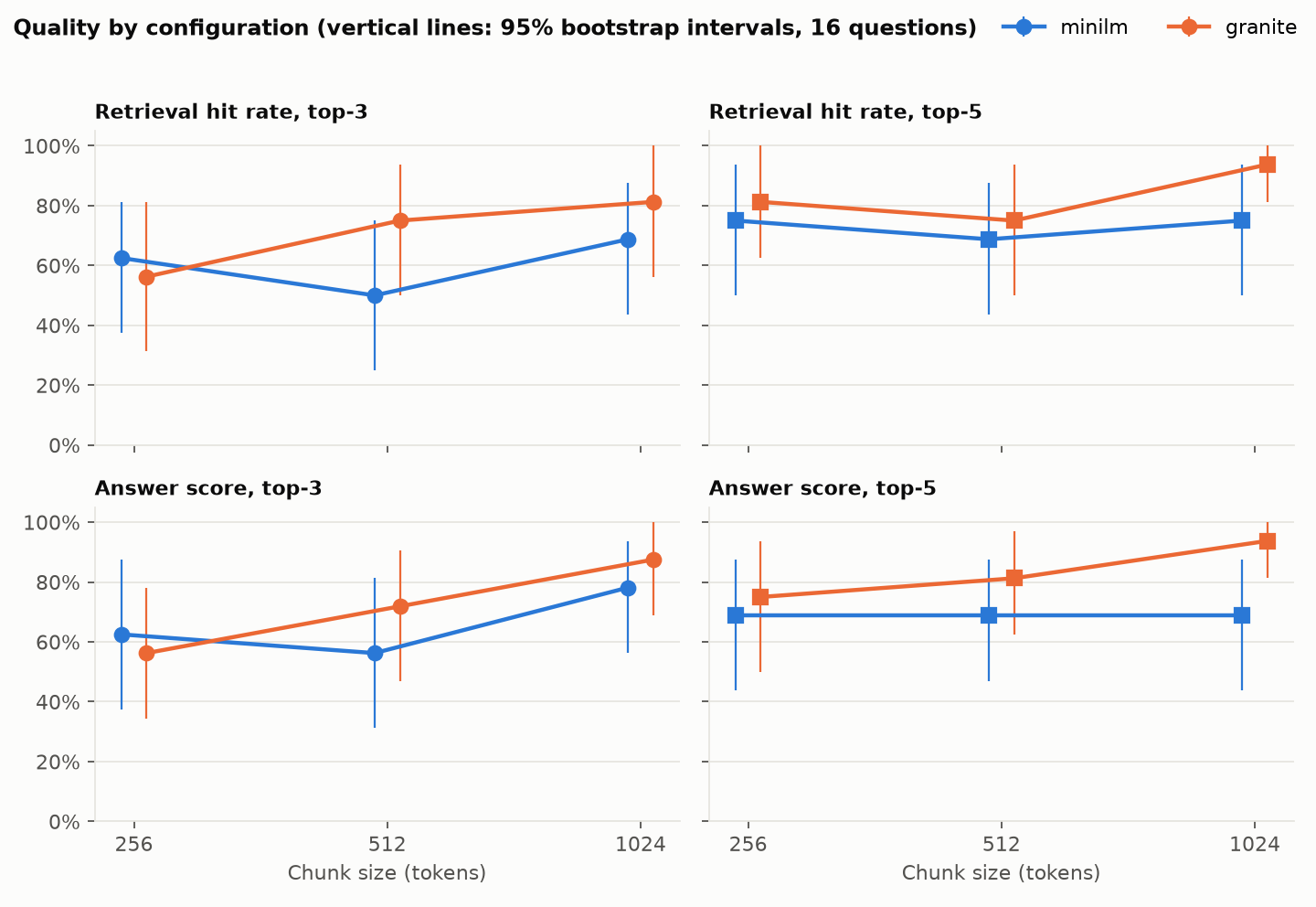
A controlled experiment comparing retrieval-augmented generation design choices on one document set and one question set: 3 chunk sizes, 2 embedding models and 2 top-k values, giving 12 configurations.
View the code on GitHubFull results
- best answer score: 1024-token chunks, Granite, top-5
- 94%
- of a 1024-token chunk is never read by MiniLM
- 73%
- hit rate from top-5 over top-3, the one separated effect
- +12.5 pts
Problem
RAG systems are usually built on defaults: a chunk size from a tutorial, a popular embedding model and a top-k of 5. Those choices decide what the model sees, but teams rarely test them. This lab replaces guesswork with a repeatable comparison that reports its own uncertainty.
Approach
- Five open-access arXiv papers and 20 hand-written questions, including 4 unanswerable ones and a near miss.
- The prompt, overlap, search method and LLM stay fixed, so only the three factors change.
- Hit rate is matched on verbatim evidence snippets, which is stricter than matching a page.
- A blind LLM judge scores answers against a written rubric, and the judge itself was audited.
- 95% bootstrap intervals and paired comparisons show which gaps can be trusted.
Results
- Only the top-k effect on hit rate clears its interval. Other results point in a consistent direction but are evidence, not proof.
- The system fails by refusing, not by inventing: all 48 unanswerable cases were correctly declined, and none of the 143 real answers was entirely wrong.
- Retrieval decides the outcome. Answers were fully correct 93% of the time after a hit and 11% after a miss.
- The judge agreed with deterministic fact matching on 94.4% of answers, and all 6 disagreements were read by hand.
Limitations
- With 16 answerable questions, one question moves a score by about 6 points.
- The corpus is 5 machine learning papers, so results may differ for contracts or manuals.
- One LLM and one run; the judge is the same model as the generator.
- Rerankers, hybrid search and semantic chunking were not tested.
Built with
- Python
- sentence-transformers
- NumPy
- pypdf
- Gemini
- Anthropic
- OpenAI